Developments In Erectile Dysfunction Treatment: A Complete Overview | #otc ed treatment

喜欢
评论
分享
Developments In Erectile Dysfunction Treatment: A Complete Overview | #otc ed treatment


Revolutionizing Erectile Dysfunction Treatment: The Promise of Gene Therapy | #best solution for erectile dysfunction
Observational Research On Stress-Induced Erectile Dysfunction Treatment: A Comprehensive Overview | #best treatment for erectile dysfunction
Top 10 Private Jet Charter Companies: A Comprehensive Examine | #private air charter
Understanding Private Jet Flight Prices: A Complete Overview | #private airline flights

Great, thoughtful observation! Here’s a breakdown of why this happened and what’s actually supported by history and anthropology:
---
1. **Image Generation Limitations**
* **AI Image Generators** (like DALL-E, Midjourney, etc.) sometimes “average out” or misinterpret phenotypes, especially for ethnicities that aren’t as strongly represented in their training data. This can result in lighter skin for groups that were historically darker, especially women, due to *modern beauty biases* in the data.
* **Photorealistic prompts** tend to make skin color variations more dramatic or inconsistent than intended, often making women appear lighter, which is not accurate for ancient populations.
---
2. **Historical & Anthropological Facts**
**Ancient India**
* **Early indigenous people** of the Indian subcontinent (pre-Aryan, Dravidian, Adivasi, Indus Valley, etc.) were generally **medium to very dark-skinned**, similar to many South Indian, Sri Lankan, or even some East African populations today.
* Even today, the spectrum of skin color in India is huge, but the ancient populations were likely closer to the darker end due to climate and genetics.
**Ancient Palestine (Levant)**
* **Ancient Canaanites, Philistines, Hebrews, and others** were not “white” in the European sense. Most genetic studies, archaeological evidence, and ancient art suggest they were **olive to brown-skinned**, more like modern Bedouins, some Palestinians, and other Levantine groups.
* Over millennia, invasions, migrations, and trade mixed the gene pool, but the *default* ancient Levantine would have been considerably darker than most modern European images suggest.
---
3. **Why Do AI/Media Get It Wrong?**
* **Colonial/Ethnocentric Bias* Most Western media and art have consistently depicted ancient Middle Easterners and South Asians as lighter than they were, due to Eurocentric standards and racism.
* **Data Gaps* There are fewer photographic references of truly indigenous, ancient, or rural people with accurate features and coloring, especially for women, so the AI often “defaults” to lighter skin.
---
4. **What Would Be More Accurate?**
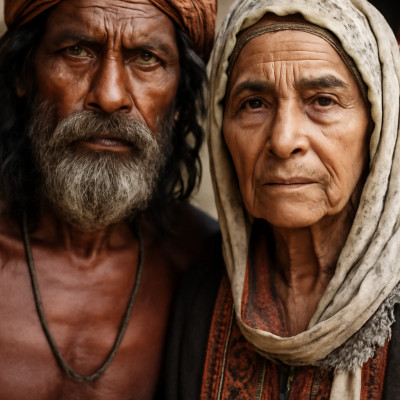
* **Both figures should be medium-brown to dark-brown.**
* The man’s skin tone is more accurate for ancient India and could also fit a very old Palestinian farmer/herder.
* The woman should likely be a shade of brown—not light or pale.
---
**Want a Correction?**
I can regenerate the image and specifically request:
* “Both subjects with rich brown skin, reflecting the ancient indigenous populations of the region—avoid Eurocentric beauty standards.”
The First image is the Eurocentric Standard, The second Image is the corrected standard for the area.
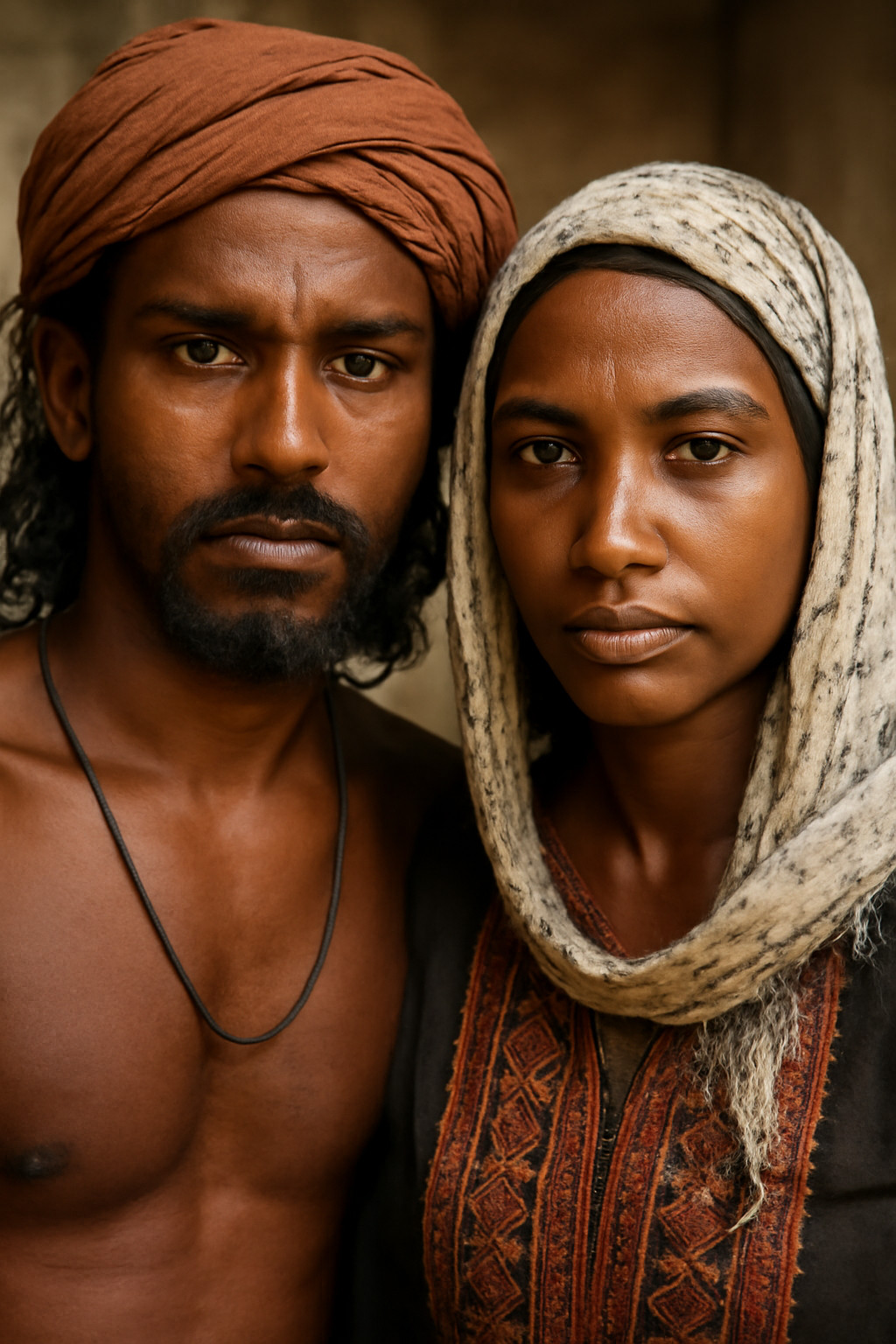
Great, thoughtful observation! Here’s a breakdown of why this happened and what’s actually supported by history and anthropology:
---
1. **Image Generation Limitations**
* **AI Image Generators** (like DALL-E, Midjourney, etc.) sometimes “average out” or misinterpret phenotypes, especially for ethnicities that aren’t as strongly represented in their training data. This can result in lighter skin for groups that were historically darker, especially women, due to *modern beauty biases* in the data.
* **Photorealistic prompts** tend to make skin color variations more dramatic or inconsistent than intended, often making women appear lighter, which is not accurate for ancient populations.
---
2. **Historical & Anthropological Facts**
**Ancient India**
* **Early indigenous people** of the Indian subcontinent (pre-Aryan, Dravidian, Adivasi, Indus Valley, etc.) were generally **medium to very dark-skinned**, similar to many South Indian, Sri Lankan, or even some East African populations today.
* Even today, the spectrum of skin color in India is huge, but the ancient populations were likely closer to the darker end due to climate and genetics.
**Ancient Palestine (Levant)**
* **Ancient Canaanites, Philistines, Hebrews, and others** were not “white” in the European sense. Most genetic studies, archaeological evidence, and ancient art suggest they were **olive to brown-skinned**, more like modern Bedouins, some Palestinians, and other Levantine groups.
* Over millennia, invasions, migrations, and trade mixed the gene pool, but the *default* ancient Levantine would have been considerably darker than most modern European images suggest.
---
3. **Why Do AI/Media Get It Wrong?**
* **Colonial/Ethnocentric Bias* Most Western media and art have consistently depicted ancient Middle Easterners and South Asians as lighter than they were, due to Eurocentric standards and racism.
* **Data Gaps* There are fewer photographic references of truly indigenous, ancient, or rural people with accurate features and coloring, especially for women, so the AI often “defaults” to lighter skin.
---
4. **What Would Be More Accurate?**
* **Both figures should be medium-brown to dark-brown.**
* The man’s skin tone is more accurate for ancient India and could also fit a very old Palestinian farmer/herder.
* The woman should likely be a shade of brown—not light or pale.
---
**Want a Correction?**
I can regenerate the image and specifically request:
* “Both subjects with rich brown skin, reflecting the ancient indigenous populations of the region—avoid Eurocentric beauty standards.”
The First image is the Eurocentric Standard, The second Image is the corrected standard for the area.
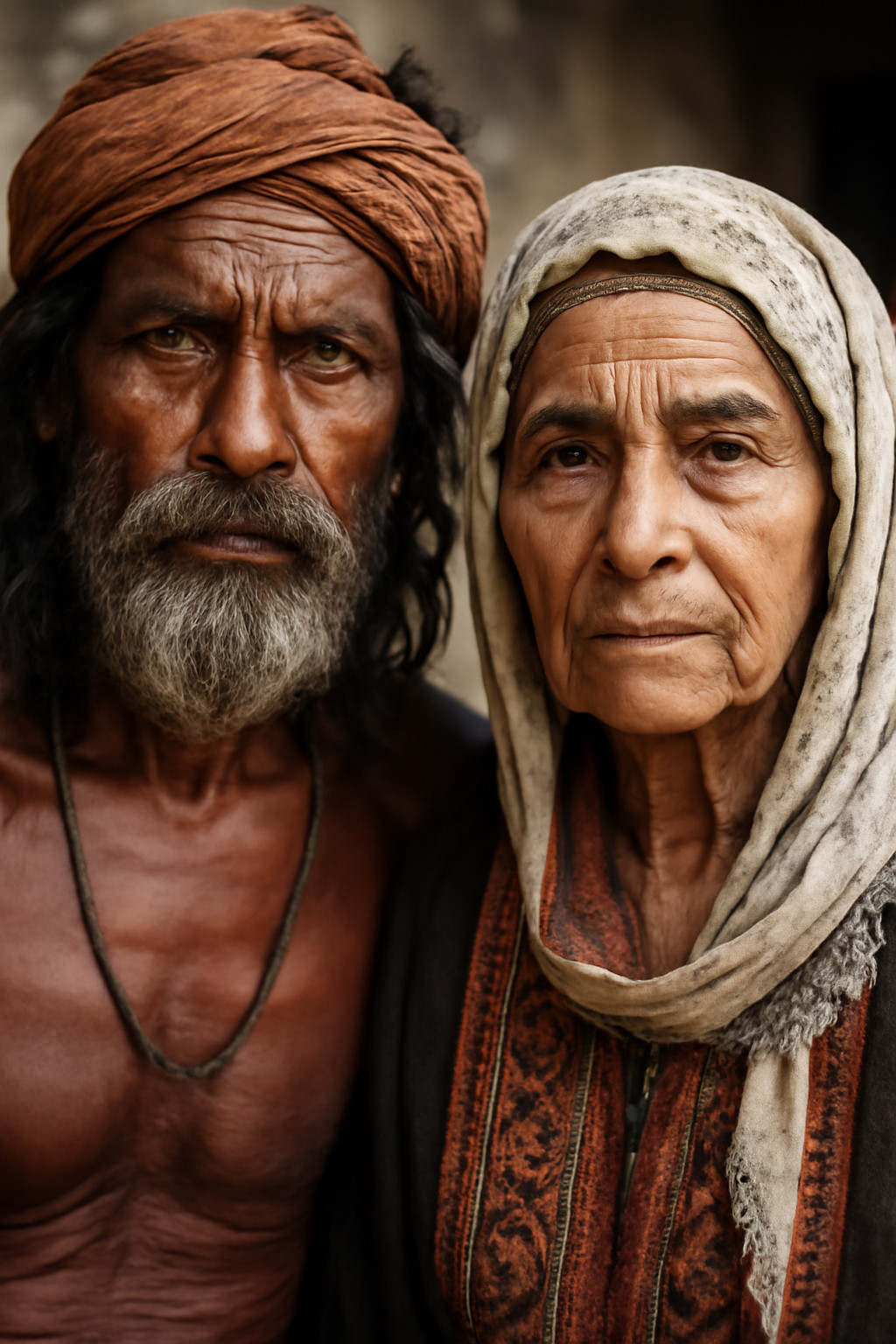
Great, thoughtful observation! Here’s a breakdown of why this happened and what’s actually supported by history and anthropology:
---
1. **Image Generation Limitations**
* **AI Image Generators** (like DALL-E, Midjourney, etc.) sometimes “average out” or misinterpret phenotypes, especially for ethnicities that aren’t as strongly represented in their training data. This can result in lighter skin for groups that were historically darker, especially women, due to *modern beauty biases* in the data.
* **Photorealistic prompts** tend to make skin color variations more dramatic or inconsistent than intended, often making women appear lighter, which is not accurate for ancient populations.
---
2. **Historical & Anthropological Facts**
**Ancient India**
* **Early indigenous people** of the Indian subcontinent (pre-Aryan, Dravidian, Adivasi, Indus Valley, etc.) were generally **medium to very dark-skinned**, similar to many South Indian, Sri Lankan, or even some East African populations today.
* Even today, the spectrum of skin color in India is huge, but the ancient populations were likely closer to the darker end due to climate and genetics.
**Ancient Palestine (Levant)**
* **Ancient Canaanites, Philistines, Hebrews, and others** were not “white” in the European sense. Most genetic studies, archaeological evidence, and ancient art suggest they were **olive to brown-skinned**, more like modern Bedouins, some Palestinians, and other Levantine groups.
* Over millennia, invasions, migrations, and trade mixed the gene pool, but the *default* ancient Levantine would have been considerably darker than most modern European images suggest.
---
3. **Why Do AI/Media Get It Wrong?**
* **Colonial/Ethnocentric Bias* Most Western media and art have consistently depicted ancient Middle Easterners and South Asians as lighter than they were, due to Eurocentric standards and racism.
* **Data Gaps* There are fewer photographic references of truly indigenous, ancient, or rural people with accurate features and coloring, especially for women, so the AI often “defaults” to lighter skin.
---
4. **What Would Be More Accurate?**
* **Both figures should be medium-brown to dark-brown.**
* The man’s skin tone is more accurate for ancient India and could also fit a very old Palestinian farmer/herder.
* The woman should likely be a shade of brown—not light or pale.
---
**Want a Correction?**
I can regenerate the image and specifically request:
* “Both subjects with rich brown skin, reflecting the ancient indigenous populations of the region—avoid Eurocentric beauty standards.”
The First image is the Eurocentric Standard, The second Image is the corrected standard for the area.
Exploring the Comfort and Luxury of Private Jet Charters Close To You | #luxury private jet charter company